-
Vestri Norse Dwarf Figurine | Hand-Carved Wooden Statue, Nordic Gnome
Regular price $112.00 USDRegular priceUnit price per -
Austri Norse Dwarf Figurine | Hand-Carved Wooden Statue, Nordic Gnome
Regular price $112.00 USDRegular priceUnit price per -
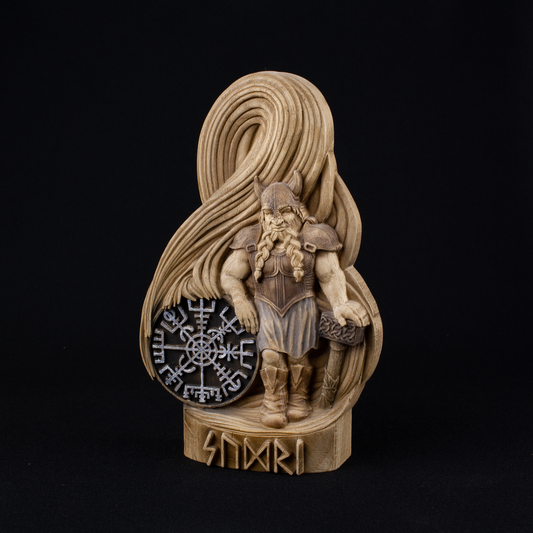
Nordri Norse Dwarf Figurine | Hand-Carved Wooden Statue, Nordic Gnome
Regular price $112.00 USDRegular priceUnit price per -
Sudri Norse Dwarf Figurine | Hand-Carved Wooden Statue, Nordic Gnome
Regular price $90.00 USDRegular priceUnit price per


Frequently Asked Questions
Who are Norðri, Suðri, Austri, and Vestri in Norse mythology?
In Norse cosmology, Norðri (North), Suðri (South), Austri (East), and Vestri (West) are the four dwarves who hold up the vault of the sky, formed from the skull of the primordial giant Ymir. First recorded in the Prose Edda, they are among the oldest and most fundamental figures in Norse creation mythology — the silent pillars upon which all of existence rests.
Can these four dwarf statues be collected as a complete set?
Yes — Norðri, Suðri, Austri, and Vestri are designed as a matching set of four hand-carved ash wood figurines, each representing one cardinal direction. Displayed together they make a powerful altar centrepiece or a striking piece of Norse home decor. Each statue is individually hand-carved in Ukraine, so no two are identical even within the set.
How can the four cardinal dwarf statues be used on a Norse or Heathen altar?
The four dwarves are traditionally placed at the cardinal points of a ritual space or altar to represent the four directions and the structure of the cosmos. They are popular among Heathenry and Asatru practitioners for directional altar work, as well as collectors drawn to rare and lesser-known figures from the Norse Eddas. All pieces are finished with lacquer and recommended for indoor use.